
Games Master Experience
The Games Master facilitates the Riskio session. Their role is to guide players through the game, explain card meanings, encourage discussion, and help teams understand the cyber‑security concepts behind their decisions.
The Games Master does not need technical expertise. Their purpose is to support learning, maintain flow, and ensure players engage with the reasoning behind each threat and defence.
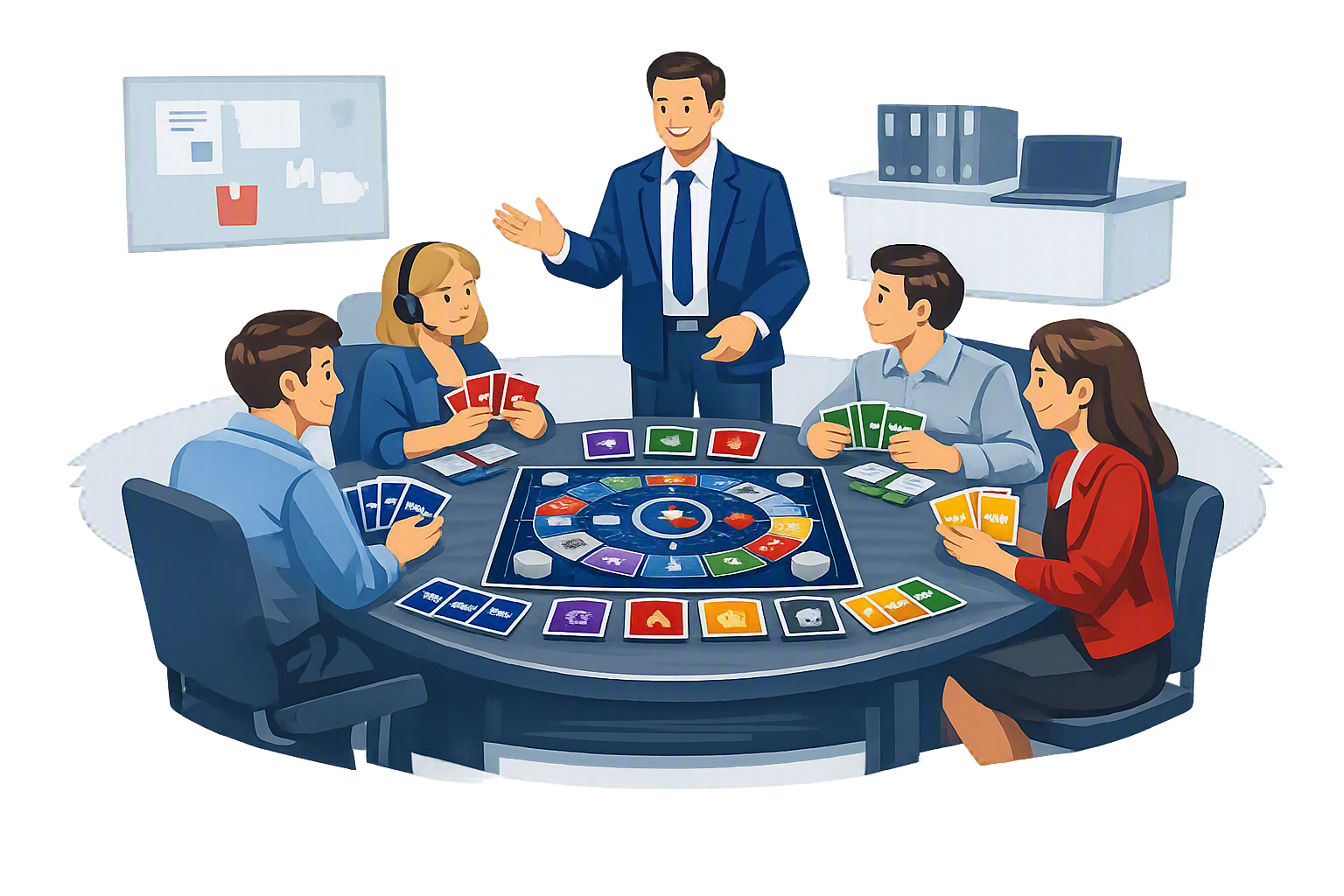
Why an Experienced Games Master Matters
Cyber security is not learned by memorising answers. It is learned through discussion, critical thinking, and understanding how attacks and defences interact in the real world.
The Riskio Games Master plays a vital role in guiding players through realistic cyber security scenarios, challenging assumptions, encouraging discussion, and helping participants connect game outcomes to real organisational risks.
An experienced Games Master helps participants:
Understand the business impact of cyber threats
Apply recognised security frameworks and controls
Develop risk-based decision-making skills
Learn from real-world attack examples
Connect game scenarios to their own organisation
Gain confidence discussing cyber security risks with colleagues and stakeholders
Unlike automated training or multiple-choice awareness courses, Riskio sessions are facilitated by an experienced cyber security professional who can adapt discussions to the audience and provide practical insights from industry and research.

Games Master
The Games Master is the facilitator and guide of the Riskio experience. They lead players through each stage of the game, ensuring that learning outcomes are achieved while maintaining pace, fairness, and engagement.
Riskio transforms complex cyber‑security concepts into interactive gameplay. The Games Master bridges the gap between game mechanics and real‑world security understanding, helping participants connect decisions made in the game to professional practice.

Learning Objectives
The Games Master helps players achieve Riskio’s core educational goals:
Understand how threats, vulnerabilities, and controls interconnect.
Recognise the importance of risk assessment and defensive prioritisation.
Develop collaborative decision‑making under pressure.
Translate gameplay insights into real organisational contexts.

Check List - Before starting a session:
Present STRIDE threat model to players.
Review the Riskio Rules Guide.
Select Game Board.
Arrange the STRIDE card of decks face down in six suits.
Give each player a set of Defence Deck of cards.
Games Master to get the Information Deck of Cards.

Rules and Guidance
Prepare the session: Set up the game board, card decks, select first player to be attacker.
Game Board: - Ensure all players can sit around the same table and clearly view the board and cards.
Explain the rules: Introduce the Threat, Defence, and Information decks and how they interact.
Guide play: Keep the game moving, clarify card effects, and encourage discussion.

Facilitation
Encourage open dialogue — the learning happens in discussion.
Use real‑world analogies to reinforce concepts highlight how each card represents a real cyber‑risk scenario.
Keep the energy high but the focus professional.
Facilitate reflection: After each round, prompt players to consider how their choices relate to real cyber‑risk scenarios.
Defence - Wait for all players to select their Defence card before starting Defence stage.

Balance and Use of Information Deck
After each round, prompt players to consider how their choices relate to real cyber‑risk scenarios.
Ensure balance: Manage time, maintain fairness, and adapt difficulty to the group’s experience level.
The Games Master uses the Information deck to test players’ defence strategies and help the gameplay.
End of each round with a short debrief linking gameplay to organisational resilience.

Facilitation Tips
Encourage open dialogue — the learning happens in discussion.
Real world attacks - Use experience to give real‑world example of attacks to reinforce concepts.
STRIDE Threats - Highlight how each card represents a real cyber‑risk scenario.
Defence Deck - Using the Defence Deck show different strategies, for example Protect vs Recover.